Lying Piriformis Stretch
The lying piriformis is the gentlest of the four core piriformis stretches because it loads the muscle in a passive cross-body rotation without compressing the back of the hip joint. It is the right choice for people who get sciatic-like symptoms from deeper stretches like pigeon or supine figure-4. The cited case report (Boyle and Demske 2009) is a reminder that buttock-and-leg pain rarely has a single fix: their patient with chronic sciatica and low back pain improved little on stabilisation and flexion exercises alone, and reached 0/10 pain only after the programme added muscle activation work (including the glute medius and glute max) alongside a hip flexibility exercise.
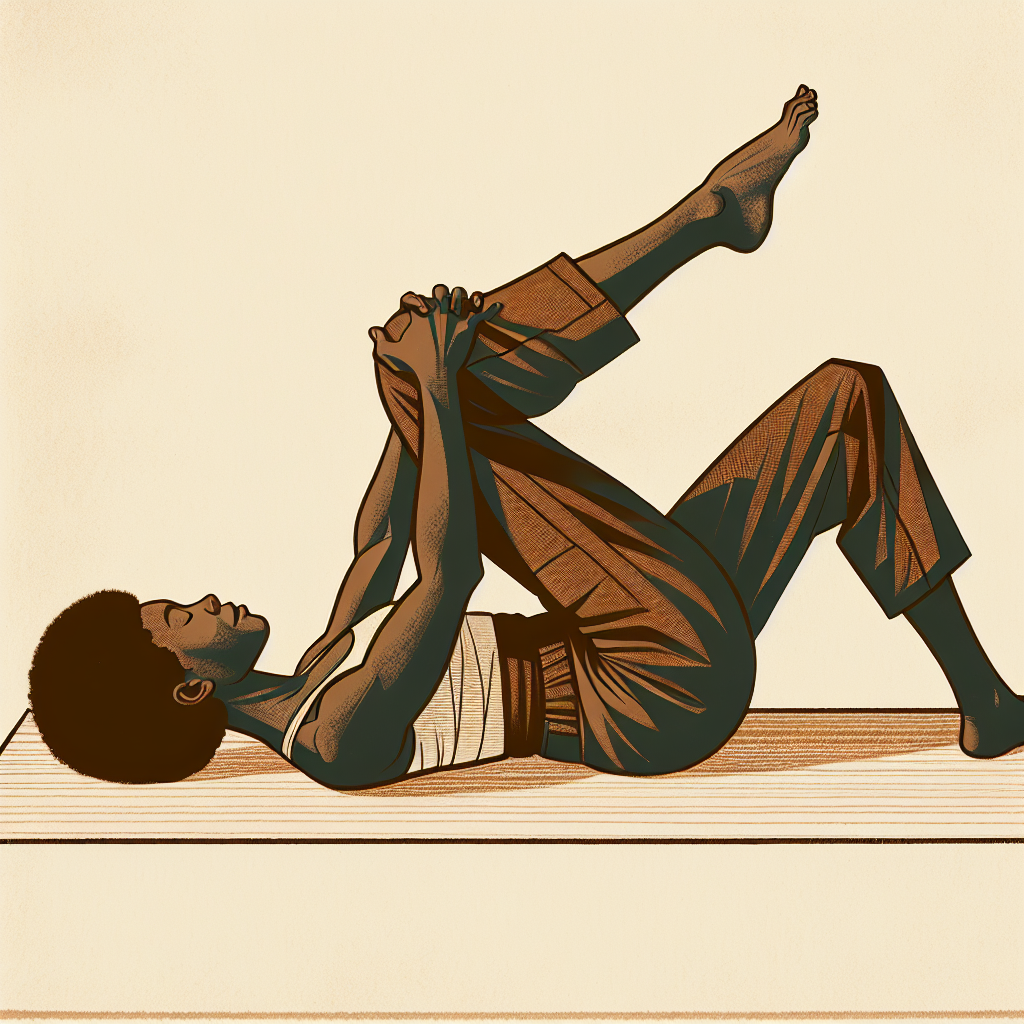
Illustration · follow the steps below for the actual technique
How to do it
- 1
Lie on your back, both knees bent, feet flat on the floor
Supine start
- 2
Cross your right knee over your body, dropping it toward the floor on your left side
Knee over body
- 3
Use your left hand to gently press the right knee down toward the floor
Light press
- 4
Keep both shoulder blades flat on the floor
Shoulders flat
- 5
Reach the right arm out wide on the floor. Hold 45 seconds. Switch sides
Reach and breathe
The evidence
The lying piriformis is the gentlest of the four core piriformis stretches because it loads the muscle in a passive cross-body rotation without compressing the back of the hip joint. It is the right choice for people who get sciatic-like symptoms from deeper stretches like pigeon or supine figure-4. The cited case report (Boyle and Demske 2009) is a reminder that buttock-and-leg pain rarely has a single fix: their patient with chronic sciatica and low back pain improved little on stabilisation and flexion exercises alone, and reached 0/10 pain only after the programme added muscle activation work (including the glute medius and glute max) alongside a hip flexibility exercise.
Citation: Boyle KL, Demske JR (2009). Management of a female with chronic sciatica and low back pain: a case report. Physiotherapy Theory and Practice · DOI: 10.1080/09593980802622677