Seated Piriformis Stretch
The seated piriformis stretch is the most realistic stretch to do during a workday because it requires no floor and no setup. It is mechanically the same external-rotation hip line as the supine figure-4, done upright. Sitting is relevant here: aggravation of pain by sitting is one of the most commonly reported features of piriformis syndrome (Hopayian 2010). But stretching is not the whole answer. Tonley and colleagues (2010) report a patient with piriformis syndrome whose treatment was limited to hip strengthening and movement re-education, with no piriformis stretching, and who finished pain-free. That is why this site pairs the seated stretch with clamshells and bridges rather than relying on it alone.
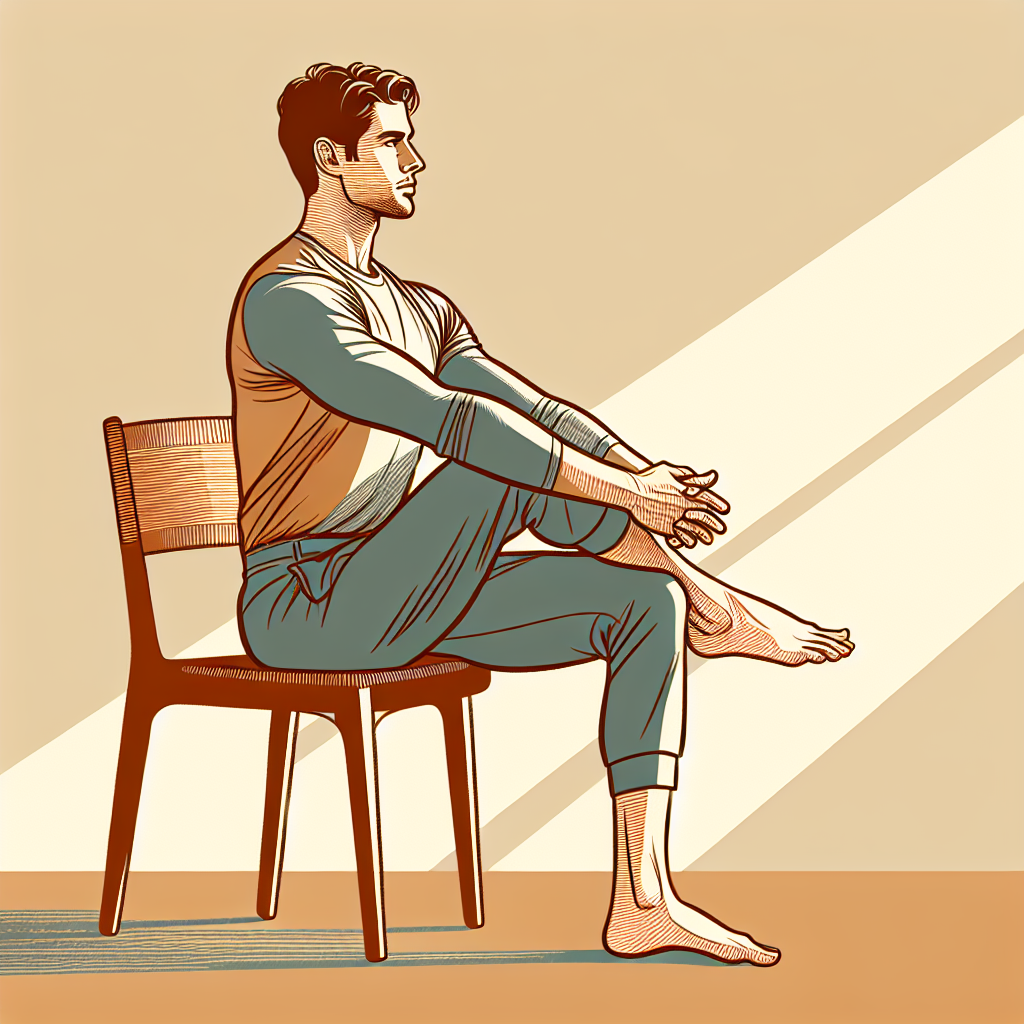
Illustration · follow the steps below for the actual technique
How to do it
- 1
Sit on a chair with both feet flat on the floor
Sit tall on chair
- 2
Cross your right ankle over your left thigh, just above the knee
Ankle across
- 3
Keep your right foot flexed to protect the knee
Flex foot
- 4
Sit tall, then hinge forward from the hips. Keep the back long, not rounded
Hinge from hip
- 5
Hold 45 seconds. Come back upright. Switch sides
Hold and switch
The evidence
The seated piriformis stretch is the most realistic stretch to do during a workday because it requires no floor and no setup. It is mechanically the same external-rotation hip line as the supine figure-4, done upright. Sitting is relevant here: aggravation of pain by sitting is one of the most commonly reported features of piriformis syndrome (Hopayian 2010). But stretching is not the whole answer. Tonley and colleagues (2010) report a patient with piriformis syndrome whose treatment was limited to hip strengthening and movement re-education, with no piriformis stretching, and who finished pain-free. That is why this site pairs the seated stretch with clamshells and bridges rather than relying on it alone.
Citation: Tonley JC, Yun SM, et al. (2010). Treatment of an individual with piriformis syndrome focusing on hip muscle strengthening and movement reeducation. Journal of Orthopaedic & Sports Physical Therapy · DOI: 10.2519/jospt.2010.3108